
The United States Navy has a long and storied history, with its ships playing crucial roles in conflicts and peacekeeping missions around the world. However, this proud legacy is shadowed by a hidden danger that has affected thousands of Navy veterans: asbestos exposure. For much of the 20th century, asbestos was widely used in shipbuilding and maintenance, prized for its heat-resistant properties and durability. This extensive use has left a lasting impact on the health of many who served aboard these vessels.
This article aims to provide a comprehensive overview of asbestos exposure on Navy ships, including the risks associated with such exposure, the types of ships most affected, and a list of specific vessels known to have contained asbestos. Whether you’re a Navy veteran, a family member, or simply interested in this important aspect of naval and public health history, this information will help you understand the scope and significance of asbestos use in the U.S. Navy.
Understanding Asbestos Use in Navy Ships
Asbestos was used extensively in Navy ships for several reasons:
- Heat resistance: Asbestos provided excellent insulation for high-temperature areas like engine rooms and boiler rooms.
- Fire protection: Its fire-resistant properties made it ideal for use in areas at risk of fire.
- Durability: Asbestos-containing materials were strong and long-lasting, ideal for the harsh marine environment.
- Soundproofing: It was used in walls and flooring to reduce noise transmission.
- Cost-effectiveness: Asbestos was relatively inexpensive and readily available.
The use of asbestos in Navy ships was at its peak from the 1930s to the late 1970s. Despite growing awareness of its health risks, asbestos remained in use on some vessels well into the 1980s.
Health Risks Associated with Asbestos Exposure
Exposure to asbestos fibers can lead to several serious health conditions:
- Mesothelioma: An aggressive cancer affecting the lining of the lungs, chest, or abdomen.
- Lung cancer: Asbestos exposure significantly increases the risk of lung cancer, especially in smokers.
- Asbestosis: A chronic lung disease characterized by scarring of lung tissue.
- Pleural plaques: Thickened areas on the lining of the lungs and chest wall.
- Other cancers: Asbestos exposure has been linked to cancers of the larynx, ovaries, and other organs.
Dr. Emily Chen, an occupational health specialist, notes, “The latency period for asbestos-related diseases can be 20 to 50 years. This means many Navy veterans are only now experiencing the health effects of their service decades ago.”
Areas of Asbestos Use on Navy Ships
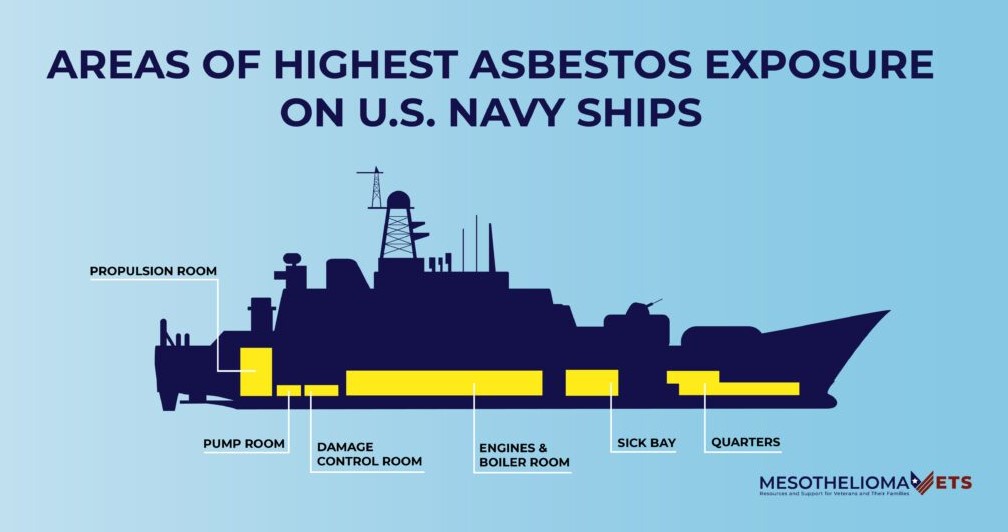
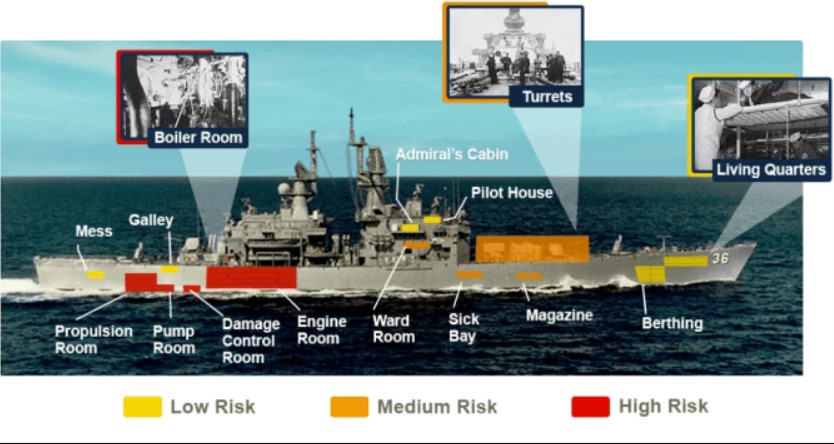
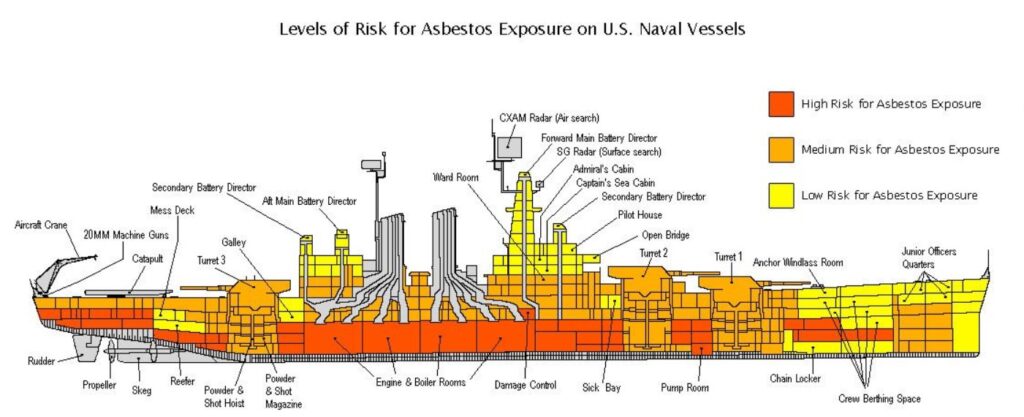
Asbestos was used in numerous areas throughout Navy ships:
- Engine rooms: Insulation for boilers, pipes, and turbines
- Sleeping quarters: Insulation in walls and flooring
- Mess halls: Flooring tiles and pipe coverings
- Navigation rooms: Electrical panels and insulation
- Weapons and ammunition storage: Fire-resistant materials
- Pump rooms: Gaskets and valve packing
Recent studies have shown that even areas not directly containing asbestos could become contaminated due to the circulation of asbestos fibers through ventilation systems.
Types of Navy Ships with Asbestos
Virtually all types of Navy ships built before the 1980s contained asbestos, including:
- Aircraft carriers
- Battleships
- Cruisers
- Destroyers
- Submarines
- Amphibious ships
- Auxiliary ships (tankers, supply ships, etc.)
Each type of ship had its own unique uses for asbestos, but all posed risks to the sailors and workers who served on them.
List of Specific Navy Ships Known to Contain Asbestos
While nearly all Navy ships from a certain era contained asbestos, some vessels have been more frequently associated with asbestos exposure claims. Here’s a partial list of ships known to have had significant asbestos use:
- USS Yorktown (CV-10)
- USS Intrepid (CV-11)
- USS Hornet (CV-12)
- USS Enterprise (CVN-65)
- USS Missouri (BB-63)
- USS New Jersey (BB-62)
- USS Iowa (BB-61)
- USS Midway (CV-41)
- USS Coral Sea (CV-43)
- USS Forrestal (CV-59)
- USS Kitty Hawk (CV-63)
- USS Constellation (CV-64)
- USS Ranger (CV-61)
- USS Saratoga (CV-60)
- USS Independence (CV-62)
This list is not exhaustive, and many other ships also contained asbestos. If you served on a Navy ship built before the 1980s, there’s a good chance you were exposed to asbestos to some degree.
At-Risk Navy Personnel
While all personnel aboard asbestos-containing ships were at some risk, certain occupations had higher exposure levels:
- Boiler technicians
- Machinist’s mates
- Hull maintenance technicians
- Pipefitters
- Electrician’s mates
- Firefighters
- Welders
- Shipyard workers
John Peterson, a former machinist’s mate, recalls, “We were always working around those insulated pipes and boilers. The air was often full of dust, but we had no idea it was dangerous back then.”
Asbestos Abatement Efforts in the Navy
The Navy began to address the asbestos problem in the late 1970s and early 1980s:
- Reduction in use: New ship designs began to eliminate or reduce asbestos use.
- Abatement programs: Efforts to remove or encapsulate asbestos on existing ships.
- Safety protocols: Implementation of stricter safety measures for handling asbestos materials.
- Training: Increased awareness and safety training for Navy personnel.
Despite these efforts, many older ships continued to contain asbestos for years, and some decommissioned vessels still pose risks during dismantling.
Legal Recourse for Navy Veterans Exposed to Asbestos
Navy veterans who have developed asbestos-related illnesses have several options for seeking compensation:
- VA benefits: Veterans can file claims for service-connected disabilities related to asbestos exposure.
- Asbestos trust funds: Many companies that supplied asbestos products to the Navy have established trust funds for victims.
- Lawsuits: In some cases, veterans may be able to file lawsuits against asbestos manufacturers.
- State compensation programs: Some states have special compensation programs for asbestos victims.
Attorney Michael Roberts, who specializes in asbestos litigation, advises, “It’s crucial for Navy veterans to understand their rights. Even if they’re receiving VA benefits, they may be eligible for additional compensation through other channels.”
Ongoing Research and Support
The impact of asbestos exposure on Navy veterans continues to be a subject of research and concern:
- Medical studies: Ongoing research into the long-term health effects of asbestos exposure and potential treatments for related diseases.
- Screening programs: Efforts to provide early detection screenings for at-risk veterans.
- Support groups: Organizations dedicated to supporting Navy veterans affected by asbestos-related illnesses.
- Advocacy: Continued push for recognition and compensation for affected veterans.
The Navy and Department of Veterans Affairs have also expanded their programs to address the ongoing health needs of veterans exposed to asbestos during their service.
In conclusion, the use of asbestos on Navy ships has left a lasting legacy that continues to affect veterans decades after their service. The widespread presence of asbestos on these vessels, from aircraft carriers to submarines, exposed countless sailors and shipyard workers to serious health risks. While the Navy has made significant strides in addressing this issue, the long latency period of asbestos-related diseases means that many veterans are only now experiencing the consequences of their exposure.
As we continue to grapple with the impact of asbestos use in the Navy, it’s crucial to raise awareness about the risks, provide support for affected veterans, and ensure that those responsible for asbestos use are held accountable. For Navy veterans who served on asbestos-containing ships, staying informed about potential health risks and available resources is essential. Regular health check-ups, awareness of symptoms, and understanding legal rights can make a significant difference in managing the long-term effects of asbestos exposure. Through ongoing research, support, and advocacy, we can hope to mitigate the impact of this hidden danger and provide justice and care for those who have served our nation at sea.